
Ever been told to “just take a deep breath” and somehow come out the other side more wound up than when you started? It’s the advice everyone hands out: apps, therapists, the well-meaning coworker, the sticky note on your monitor. It’s free, it’s portable, and, I mean, it sounds simple enough.
So you give it a shot. And it goes something like this:
In for four… hold for four… out for four... hold for four... and over and over.
By the third round, your fingertips are tingling. Your chest feels tight, like you can't quite get the air all the way in. And now, on top of whatever stressed you out in the first place, you're anxious about your breathing.
Great. Very calming. Thanks, guys.
If I bring up breathing or relaxation exercises in my (virtual) office, I can practically watch some clients suck in their breath as they prepare to tell me all the things they've tried before ...and all the ways it didn't work.
I never feel relaxed.
I can't find the time for it.
I get bored/distracted/irritated.
It makes me anxious.
I can't catch my breath when I'm doing it.
It just doesn't work for me.
And confession? I cry a little inside when I hear this. Cuz I'm a breath person. I do it, I teach it, I believe in it. And I know it does work for plenty of people. But I've sat with enough people who don't "get it" right away to know that it isn't a you problem. It's a goodness of fit problem.
So why does deep breathing make you anxious?
Because a breathing exercise asks your body to take something it normally does on autopilot and do it on command, with you watching closely, probably when you're already stressed. For a lot of nervous systems, that combo doesn't read as "things are totally chill here, y'all." It reads more like "uh, what's wrong... why are we doing this... and why doesn't it feel right?"
It's not random, either.
A few specific things tend to turn a calming exercise into an anxious one. Here's a quick way to spot which one's happening for you:
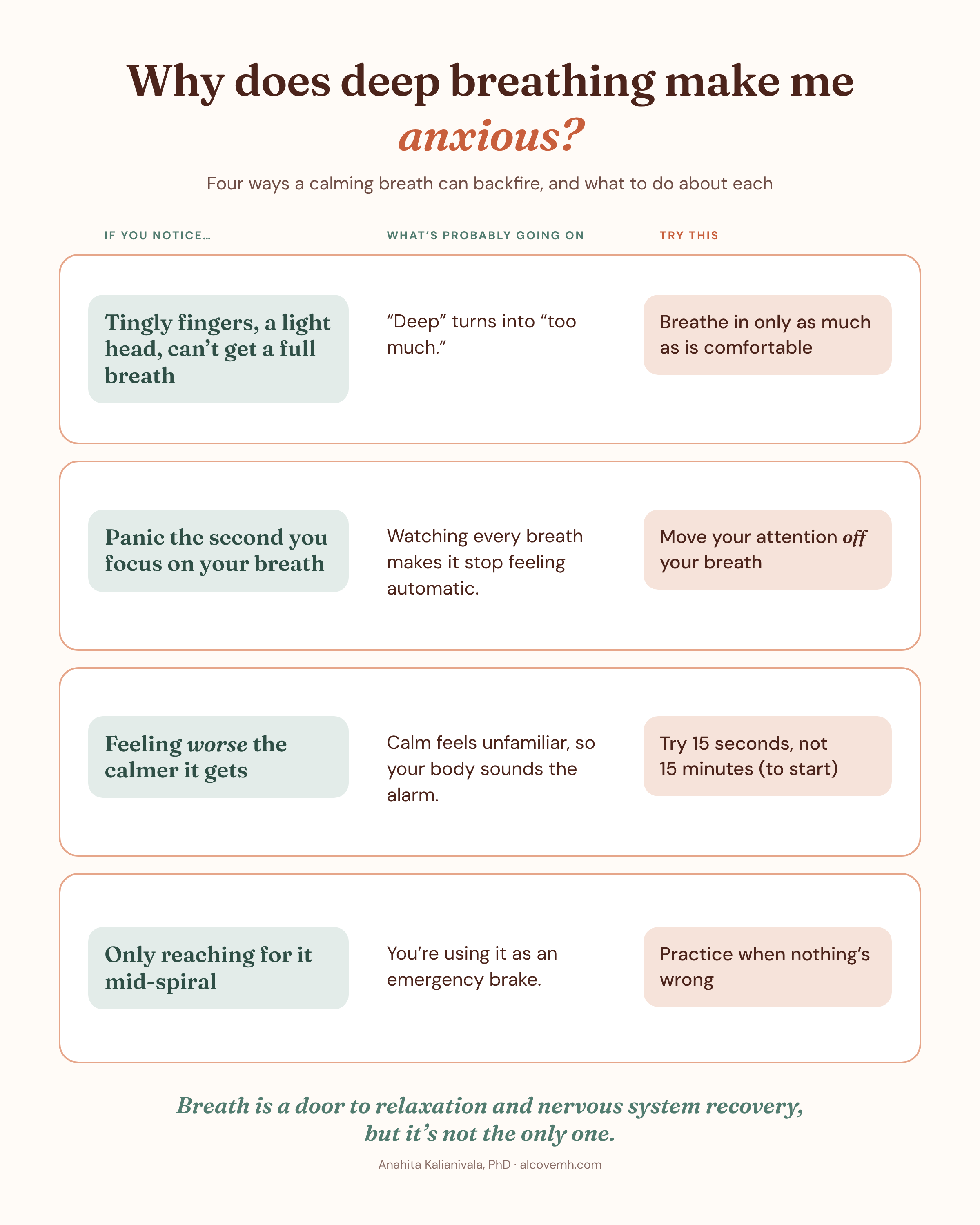
Keep reading for the full breakdown of each.
Can deep breathing cause hyperventilation?
It can. Somewhere along the way, "take a deep breath" got translated into "fill your lungs to capacity, repeatedly, as if your life depends on it."
But bigger isn't better here, especially if you're not used to diaphragmatic or deep breathing. When you move more air into your lungs than your body needs in a given moment, you also blow out more carbon dioxide than usual. That can bring on lightheadedness, tingly fingers or lips, and that maddening feeling of never getting a satisfying breath.
And here's the cruel part: those sensations feel a lot like anxiety. So you try to breathe better, which usually means breathing bigger… which brings on more of the sensations, which makes you try harder. And so on... If you've read my blog post "why you can't relax even when you have free time," you'll recognize this merry-go-round. This is just the deep breathing version. 🙃
Try this:
Breathe in as much as is comfortable.
Let that be different from breath to breath. Some will be bigger, some smaller, and that's fine.
And if you're already lightheaded, pause and sit or lie down somewhere supported. Permission to quit or take a break from the practice, too.
Smaller, easier breaths give your body a chance to rebalance, so the tingling and lightheadedness can settle down on their own.
Why does focusing on my breath make me panic?
Breathing is supposed to run itself. The second you put it under a microscope, it stops feeling automatic.
Is this one deep enough? Why does it catch at the top? Did I finish the exhale? Am I getting enough air?
If you already keep a close eye on your body (like a lot of people living with anxiety or chronic pain), a practice that puts every sensation on center stage can be a lot. And for many of the people I work with who live with pain, "breathe into your belly" basically means "go hang out next to the part that hurts." Hard pass, right?
Try this:
Move your attention off your breath.
Keep your eyes open and let them land on something in the room.
Or try something tactile, like finger tracing: slowly follow the outline of one hand with a finger of the other, no breath-timing required.
Both of these strategies release the focus on an internal sensation and instead give your attention a neutral place to land that isn't something you're already worried about.
Why does a calm breath feel so uncomfortable?
Even when a breathing exercise "works," calm comes with its own sensations. Your heartbeat slows, your limbs feel heavier, your hands get warm or tingly, your stomach might even gurgle. If you're not used to feeling those things, or you're used to keeping a close eye on your body, unfamiliar can easily register as wrong.
Researchers studying relaxation-induced anxiety have pointed to exactly this: fear of the body sensations that come with relaxing, and the feeling of losing control as you let go.
So the alarm goes off, not because something is actually dangerous. But alarms are designed to get your attention to something that might be risky, right? So since your body doesn't recognize this kind of calm yet, it wants you to scan and be sure things are ok.
And here's the tricky part: if you don't know this is happening, it's easy to take the alarm at face value. My body is freaking out, so something must be wrong.
But an alarm isn't proof of danger.
Sometimes your body is just flagging something new and harmless, and what it needs isn't a full investigation. It needs a little reassurance, kind of like a three-year-old who bursts into tears at the mere thought of stubbing their toe. You don't call 911. You scoop them up and say, "I know, buddy. You're okay."
(If calm in general makes you feel on edge, I dig into that in why you can't relax even when you have free time.)
Try this:
Keep the practice short.
Try a tiny sip first. Like, do five seconds of a practice instead of a full 20-minute guided exercise. And if that was stupid easy? Great! Still recalibrate before you dive back in, e.g., open your eyes, look around the room, stretch or wiggle. Then, try again, if you like.
As each level of practice feels safe and non-jarring, increase the intervals, e.g., 7 seconds, 10 seconds, 30 seconds, etc.
Small, repeated doses are how your body learns that heavier limbs and a slower heartbeat aren't an emergency. They're just what calm feels like.
Why don't breathing exercises work for me?
Think about when most of us actually reach for a breathing exercise. At 11:52pm, when you're lying in bed, unable to sleep, can't concentrate on your romantasy at your bedside, and your brain has decided now is the perfect time to replay every word of that email you sent to your boss politely declining an extra 15 hours of work this week without any compensation.
Your heart's thumping. Your mind's reeling. You're frustrated to even be in this spiral and you're trying to keep your tears from waking your partner.
Then you remember: wait, breathing is supposed to help.
So you grab your phone, open the first YouTube option, pop in the earbuds, and hit play.
There's nice music. A soothing voice. An easy practice (or so they say). But two minutes in and you can't keep your eyes closed as suggested. In fact, you're not even lying down anymore; you're shifting to seated wondering why your belly won't breathe like they say it's supposed to.
So now it's nearly midnight and you're 2 hours past your bedtime, awake and annoyed.
That's the problem with only pulling out your relaxation or breathwork tools in an emergency.
Breathing techniques work best when they're practiced on regular, boring, nothing's-wrong days, so your body already knows them by the time things get hard. Saving them for 11:52pm spirals is a little like trying to learn to swim while you're already going under. It sets the whole thing up to fail.
And if you've tried three apps, two teachers, and the breathing gadget your sister swears by, it's easy to decide you're the problem. But you aren't. You were just handed a tool that doesn't fit where your nervous system is right now.
Try this:
Practice when nothing's wrong.
Pick a boring, low-stakes moment you already have: waiting for the kettle, right after you brush your teeth, the first minute after you sit down at your desk. And practice then. Just a minute or so. Nothing fancy. Let it be easy.
Then, on the 11:52pm nights, when you're stressed and wondering if breathing can help, you're not asking your taxed nervous system to yank its way to something new and unfamiliar. Now, you're inviting it to try something it's already seen be safe.
And if it still doesn't "work" that night? That's okay. You showed up for a new way to handle things. And that counts.
So breathwork is just not for me, ever?
Honestly? I hope it is. (Breath person, remember?) A lot of people find their way back to breath once their system is a little less braced, usually starting with gentler versions of unwinding the nervous system.
And if you're already working with a therapist or teacher on this and still struggling, get specific about what is and isn't working for you when you practice. Saying "Breathing doesn't work for me" could mean a lot of different things. So try being more specific, like:
"I get dizzy when I take big breaths."
"The pauses make me feel like I can't get enough air."
"I can't stop paying attention to every single breath."
That gives them something concrete to work with, so they can help you find a version that actually fits you.
And if breath never becomes your thing? That's okay too. It's a door to relaxation and nervous system recovery, but it's not the only one.
A quick (but important) medical note
This post is about the anxiety side of breathing, and it isn't medical advice. Please don't assume new or unexplained breathing symptoms are "just anxiety."
If you have severe shortness of breath, chest pain, or you faint, call 911 or get emergency care right away.
If dizziness or breathlessness keeps coming back, get it checked by a medical provider, since hyperventilation can have medical as well as emotional causes. And if a clinician prescribed breathing exercises for a medical condition (like asthma or COPD), check with them before changing check with them before changing or ditching the plan.
Different kinds of struggles with breathwork call for different kinds of help.
If panic attacks are coming often, or you've started avoiding exercise, stairs, or anything else that changes your breathing, look for a therapist who specializes in panic and anxiety. The Anxiety & Depression Association of America's therapist directory is a good place to start. And if you're ever in crisis, you can call or text 988 any time.
If chronic pain is part of the picture, that's my lane. When your body hurts most of the time, being asked to tune into it can feel like a trap, so the "just breathe" advice usually needs some tweaking before it fits you and your life. If you want someone who actually gets how to help with chronic pain and stress, learn more about working with me here. (Telehealth for eligible clients in Nevada and PSYPACT states.)
Want practices that don't start with your breath? Regulate™ is my self-guided library of 17 guided audio practices and educational videos, organized so you can start where your nervous system actually is. Some practices use the breath; plenty don't, including a new bonus finger-tracing lesson. Pick what fits.
Regulate is offered by Studio AZK LLC, separately from Alcove Mental Health's therapy services. It's self-guided education, not therapy or individualized treatment. This article is general education and doesn't replace individualized mental health or medical care.