
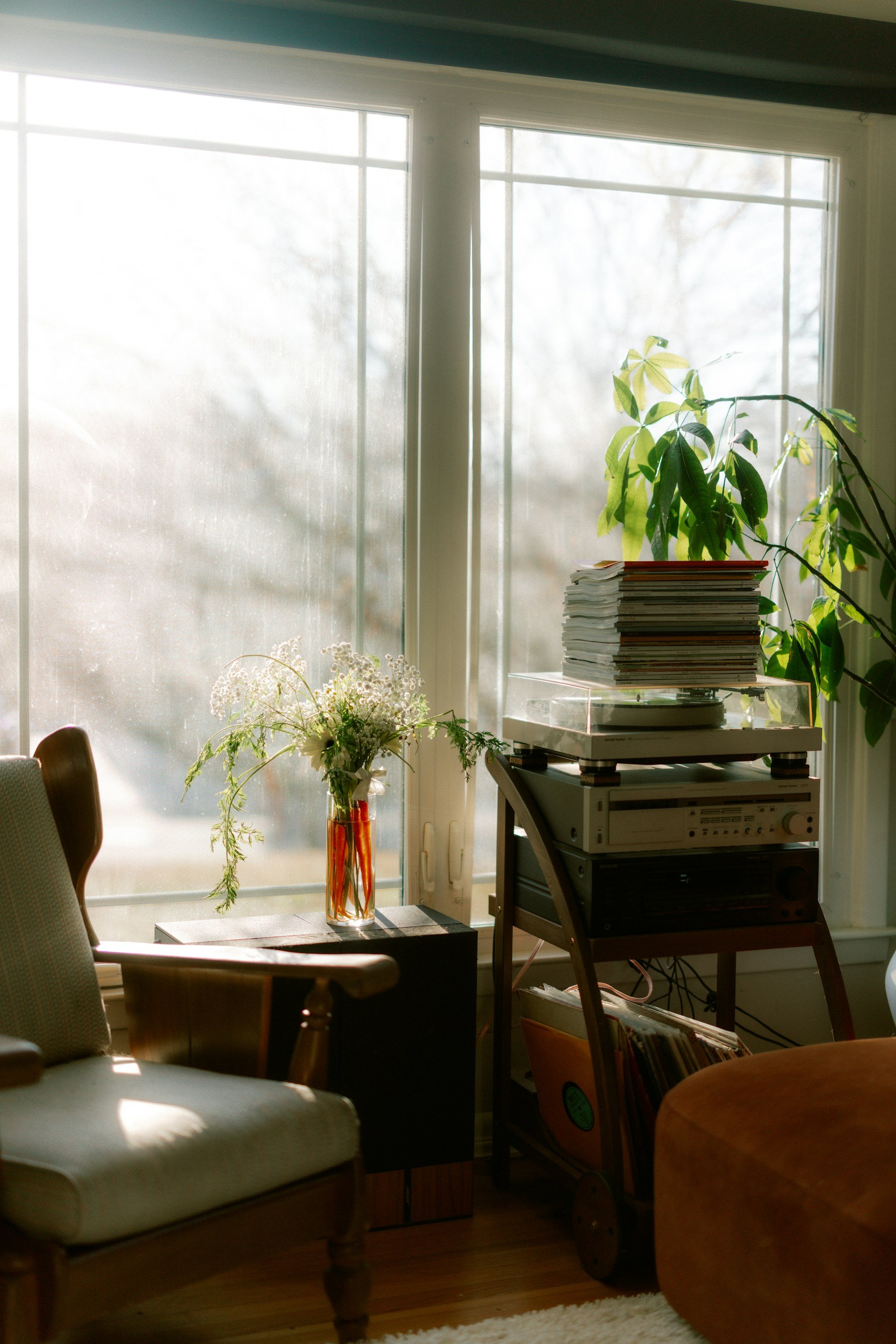
Picture it: Saturday morning, 7am. You woke up early because you have a healthy AF sleep rhythm and the house is quiet. You're sipping your coffee in the cozy chair, no one else around to fight you for it. And you release a heavy, contented sigh.
You've been fantasizing about breathing room like this for weeks. Especially after a 60-hour work week, pushing through a deadline.
And now you're… looking around the kitchen, noticing all the things that need your time and attention. The stack of unopened mail, the free coffee coupon you don't want to waste, the new banking documents you need to find a home for, all the empty spice jars that need refilling. (So much for nothing on the to-do list, right?)
You tell yourself, "Well, I can just write those things down so I don't forget… it's not like I have to do them right now..." And all of a sudden you're up. You've relinquished dibs on the comfy chair, you're grabbing an envelope and your kid's leftover marker to make a list.
[20 minutes later]
Your hair is up in a get-$hit-done bun, your coffee is following you around like a cadet on marching orders, and you're doing things that aren't even on the list yet because just this one thing first.
Sound familiar? That's either because you are stalking my quiet mornings or because you're just in good company 😂
Not being able to stop the doing is one of the complaints I hear most often from the capable, over-functioning women I work with. It can sound like:
I finally have time to rest, and I can't do it.
I don't know how to just… sit there.
I feel guilty if I'm not being productive.
I'll relax once everything's done.
If I slow down, that's when I notice the pain.
I know this one from the inside, too. For years I ran the high-achiever formula (work hard, meet the standard, get the approval, repeat). And it led me to treat rest like it was a reward that I earn only after the checklist is done.
Spoiler alert: the checklist is never done.
So why can't you relax, even when you finally have the time?
There's a difference between having the time, technically, and having the capacity to "stand down" against a nervous system so used to feeling like everything is urgent that it doesn't even check to notice that you're off-duty.
...unfortunately.
If you've spent months (or years) running on deadlines, taking care of other people, fighting off chronic pain or symptoms, and living that full-calendar life with cute boots and a smile, then being on is your normal.
So when you finally have an opportunity to stop the "doing," your system doesn't know how to compute. It doesn't take the slow exhale you hope it would. It doesn't loosen the muscles that have been pushing you through the past week.
Plus, conveniently, there's always something else that could get done... so it's not like you even have the mental reprieve of noticing, wondering if it can wait, trying (and failing) to choose yourself instead of the task.
So why are you like this?! Let's first clarify - your body isn't refusing to relax because you're bad at resting. It's just doing exactly what it's been trained to... When you spend a long stretch pushing through, your nervous system learns that staying revved is how you make it through the week. How you get stuff done, how you knock the socks off everyone around you, how you keep being the person who's asked to save the day. [Swoosh that cape 🦸]
The problem is, that being on becomes the default setting for your nervous system, and the longer and more often you stay there, the more "normal" your system perceives that state to be. Said differently, your nervous system can learn to register "not doing" as dangerous.
After all, the less familiar and the unknown is evolutionarily the thing that's scary.
So instead of your system easily downshifting when it has the space and time, it goes looking for the next thing it can handle with all its bada$$ery.
Like, why would you want to turn off that skill?
Being able to rally, to push through, to be the one who gets it done when everyone else is flailing is a big part of why people trust you with the hard stuff. I'm not here to take your cape away.
But every superpower comes with a cost.
When pushing through is the only gear you've got, your body never quite gets the memo that the emergency is over. Or that some tasks aren't urgent. Or that rest is allowed - even necessary. Then, that cost starts to show up in other places: the Monday-morning doom, the pain flare that hits as soon as you finish a big project (or a fun weekend), the time-off that you spend sick because your body figures it's the best time to overhaul your immune system.
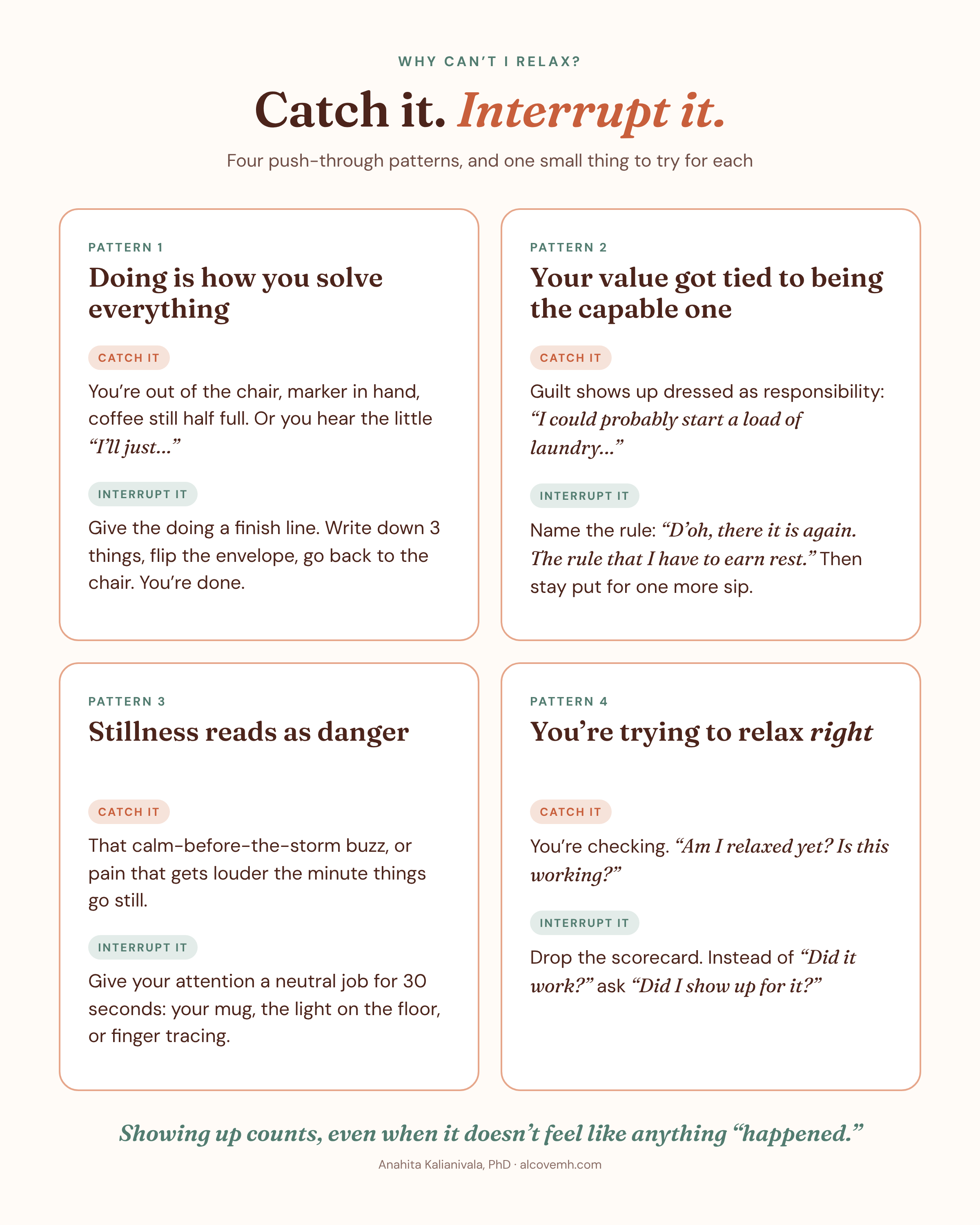
It's not random, either. A few specific patterns tend to keep that push-through mode running (click any one to skip ahead):
Doing is how you solve everything. So rest turns into a project.
Your value got tied to being the capable one. So stepping back feels like letting someone down.
Stillness reads as danger. So slowing down sets off the alarm instead of switching it off.
You're trying to relax right. So it becomes one more thing to fail at.
Keep reading to take 'em one at a time with me.
Why do I always feel like I need to be doing something?
Think about how you've handled basically every hard thing in your life. You made a plan. You researched. You figured it out and you got it done. Doing is how you've solved every other problem, so of course it's your first move in your personal life, too.
Which is why, when your body starts waving red flags (e.g., with migraines, fibromyalgia flares, nerve pain), you don't just want answers. You want something to do about it. (Like, if we can't fix this why do we even know about it, right?!) So you overhaul your diet, start the workout plan, buy the fancy journal, curate your feed until every other post is about nervous system regulation. The result? Even your rest has turned into a project to execute, complete with AI bots and spreadsheet scorecards.
That's what happened in the kitchen on Saturday. The list wasn't a way to set things down so you could relax. It was your system finding the nearest thing to fix, because fixing is the strategy you trust. Sitting in the chair with nothing to solve doesn't register as relaxing. It registers as falling behind.
Why do I feel guilty when I'm resting?
If you're the one people call when something needs handling, being capable isn't just a skill anymore. It's how people see you--the reliable one, the strong one, the one who's got this. Then suddenly (oops) it becomes how you see yourself, too.
Somewhere along the way, your worth gets tangled up with how useful you are. So when you stop being useful, even on a Saturday morning to an empty kitchen, it doesn't feel like you're taking a well-deserved break. It feels like you're betraying a core part of who you are. Or your family, your team, your clients, your own standards. So what business do you have relaxing in your pajamas now?!
Cue the guilt.
And here's the particularly pesky thing about it... guilt rarely introduces itself by name. Instead, it shows up sounding like responsibility, like the reasonable grown-up in the room, like "but it won't hurt if I do just this one thing." Which makes it really hard to argue with… unless you know what to listen for.
Pay attention to what your mind says the next time you sit down without a laptop in front of you.
Is it "Ahh, this is nice"?
Or does it go, "Actually, I could probably start a load of laundry while I'm sitting here."
If it’s the second one, there's your sign... Like, notice how reasonable that sounds. Helpful, even. And yet it's not necessary but it still feels unsettling to leave alone.
That’s the tell.
It’s the earn-your-rest / feel-guilty-if-notice-and-don't-do-it dressed up in sensible shoes. And it never runs out of "helpful" suggestions.
Why does relaxing make me anxious?
Does a calm moment ever feel like the calm before the storm? Like you can’t fully enjoy it because part of you is already bracing for what’s next? If so, you’re not alone. Some folks actually feel worse when they try to relax.
Researchers have a name for this, relaxation-induced anxiety, and they've known about it since the 1980s. In a more recent 2019 Penn State study, researchers tried to figure out why it happens. They had people do a relaxation exercise, then showed them a video designed to make them feel scared or sad, basically yanking them from calm to upset on purpose.
Then they had everyone relax again. Interestingly, the people who got most anxious during the second relaxation trial were the same ones who reported disliking that calm-to-upset whiplash the most.
The theory goes something like this: if you stay a little bit braced, whatever bad thing comes next won't knock you over as hard. Letting your guard down feels like volunteering to get blindsided. So worrying becomes a weird kind of insurance policy.
And I see this same logic all the time in the folks I work with, especially those juggling high achievement, perfectionism, or people pleasing. If you've spent years being the one who catches everything before it falls, staying braced isn't a marker of stress. It's a marker of protection.
And if you live with chronic pain, you probably know that whiplash in your body, too. It's why good days can sometimes feel like the worst: because you're bracing for the drop, whether it's a dip back down to baseline or a crash into a pain flare.
There's also the added layer of what your attention does when your body stops moving. If you keep busy, your attention has a million other places to go than your symptoms. But when you stop, the ache in your back or the pressure behind your eyes suddenly has the floor to itself. And pain can get louder, more unbearable, harder to ignore.
So stillness doesn't just feel unfamiliar. It can actually feel worse (at least at first). No wonder part of you would rather get up and do something. Anything.
Why can't I just make myself relax?
Because the second "relax" becomes the primary goal, it turns into a job with a performance metric. And you, my capable friend, know exactly what to do with a performance goal: monitor it. Am I relaxed yet? How about now? Now?
So you try the meditation app and last four minutes before your brain starts reading you the to-do list. You try the breathing exercise and somehow feel more panicky, not less. (That one's really common, by the way. Here's why deep breathing can make anxiety worse.) You try savasana and it feels like lying in a puddle of your own stress.
And then you conclude you're just bad at relaxing. But you're not. And you weren't supposed to be grading yourself on it to decide, either. Why? Because no one relaxes when they're being constantly monitored and marked up. 😂
All that checking is vigilance, which is pretty much the opposite of what you were going for. And it doesn't just cancel out the rest. It kicks off a loop.
Scanning for whether you're relaxed yet tells your system there's something to keep an eye on, so it stays on alert. Staying on alert means more tension, a faster heartbeat, shallower breaths. And because you're busy scanning, you notice all of it. Your system reads those changes as proof that something's off, so it turns the volume up even more, pain included. Which gives you more to check.
You feel the merry-go-round vibes, yet?
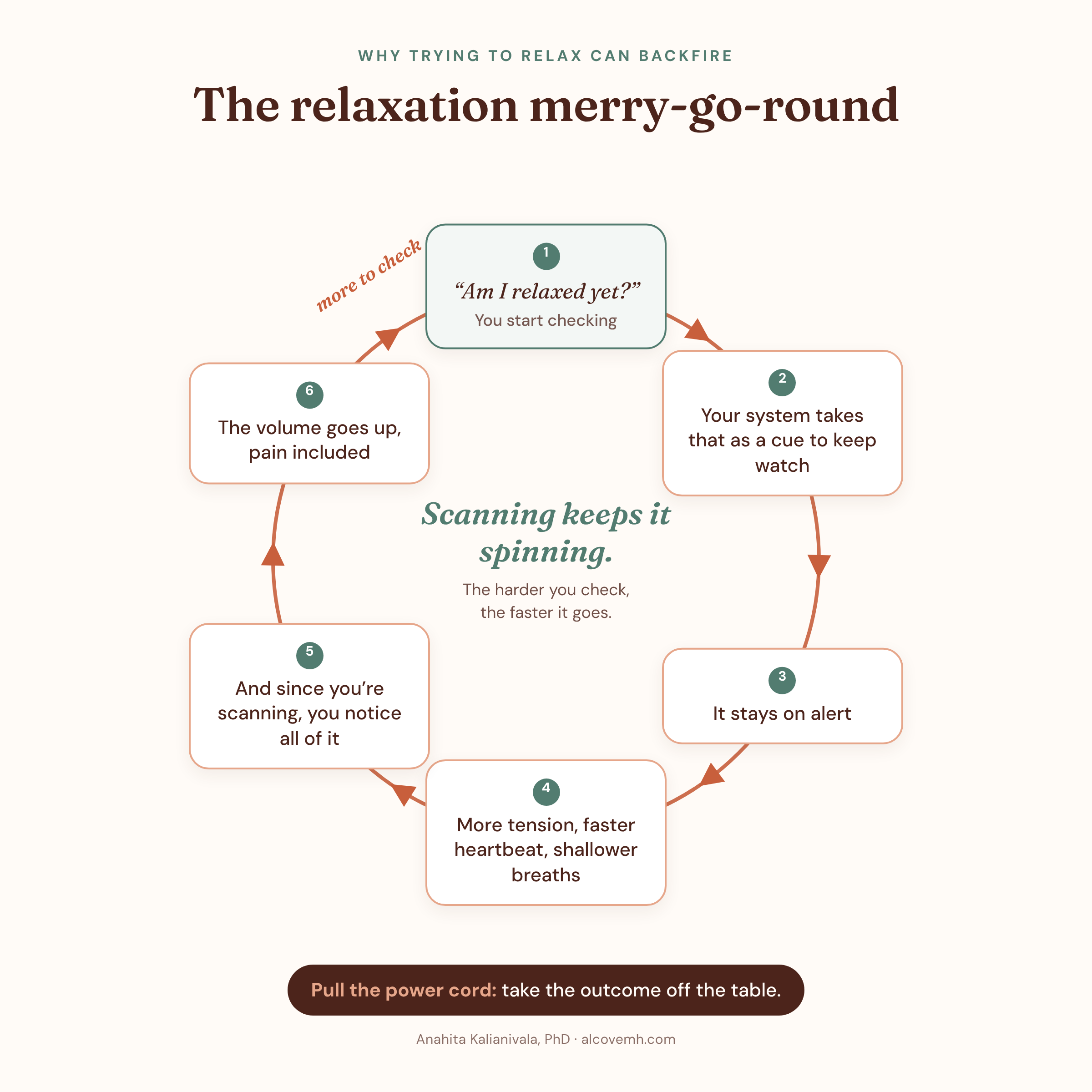
Bottom line: the harder you try to relax, the more wound up, watchful, and achy you can end up. Not because you're doing it wrong, but because trying hard is exactly the signal your nervous system has learned to associate with being on-duty, instead of being at ease.
How do I actually start relaxing (without turning it into a project)?
Here’s the good news: you don’t have to "be better at relaxing" before you actually get a break. You just have to (1) notice your push-through patterns and (2) start to interrupt them somewhere.
The starting place isn't a 30-day self-regulation challenge or magically becoming a meditation guru at 5:30am. When I work on this with clients, we start with catching yourself in the act. Like, can you call yourself out when you bulldoze through the easy Saturday morning? Or when you try to cram an extra email into your wind down buffer?
Then we move to interruption. That is, once you catch it, can you make one, single different decision? Like, the next stupidly easy step.
You don’t need to reparent your inner child or fix all your unhelpful patterns before you’re allowed to finish your coffee.
Here’s one small thing to try for each, the kind you can actually pull off at 7am in your pajamas with your kid’s marker still in hand, waiting to kick a post-it's ass.
If doing is how you solve everything
Catch it: You're out of the chair, marker in hand, and your coffee's still half full. Or you hear the little "I'll just…" starting up.
Interrupt it: Give the doing a finish line. Don't let it run hog wild. Set a limit, like 3 things. And then write down the first 3 you think of. Then, flip the envelope over, and go back to the chair. That's the whole task. You're done.
You're not trying to talk your fixer brain out of fixing. You're giving it one small, contained job with a clear end, so it gets proof that nothing's going to get lost and it's still safe if it stands down. And if going straight from a 60-hour week to doing nothing feels like too big a jump, build a ramp: something that asks less of you than whatever you just stopped. A familiar song. A few pages of a book. A slow lap around the block. Not productive, but not the void of achievement, either.
If your value got tied to being the capable one
Catch it: The guilt shows up dressed as responsibility. "I could probably start a load of laundry while I'm sitting here."
Interrupt it: Name the rule for yourself. A la, "D'oh there it is again. The rule that I have to earn rest." Then stay put for one more sip. (No judgment what you do between that and the 2nd sip.)
Naming it turns the guilt from a fact into a thought you're having, and a thought is something you can notice without obeying. You don't have to win the argument about whether you deserve rest. You just have to stop the auto-pilot of the rule deciding what you do next. (And guess what? The laundry will be exactly as dirty in twenty minutes. 🙃)
If stillness reads as danger
Catch it: That calm-before-the-storm feeling. Your body starts to buzz, or the pain gets louder the minute things go still.
Interrupt it: Give your attention a neutral job for thirty seconds. Keep your eyes open and let them land on something that isn't a problem: the color of your mug, the light on the floor. Or try finger tracing, slowly following the outline of one hand with a finger of the other, letting your attention sink into the neutral sensation.
A nervous system that's learned "not doing" is risky can't be talked into feeling safe. It needs to learn by experience. Tiny moments, small enough that they don't flood your system, and repeated enough that when you show your self nothing bad happens when you slow down, it slowly re-learns.
If you're trying to relax right
Catch it: You're checking. Am I relaxed yet? Is this working? Why isn't this working?
Interrupt it: Drop the scorecard. Instead of "Did it work?", ask "Did I show up for it?" Did you sit back down? Did you do the thing you know is good for you, even for two minutes? That's the win, whether or not you feel any different afterward.
Remember the merry-go-round? Scanning for results is what keeps it spinning. But taking the outcome off the table pulls the power cord. Think of it like any other healthy habit. You don't quit brushing your teeth because one brushing didn't visibly change anything. Rest works the same way: you're building trust with your body every time you do something differently. Every time you keep a promise to care for it.
And that counts even on the days it doesn't feel like anything "happened."
Want ideas that fit between meetings, not just on spacious Saturday mornings? Try these five-minute nervous system exercises for busy days. And just pick 1 to start; don't give yourself five new homework assignments in the name of relaxation.
When is it more than a busy brain?
Here's something nobody tells you about slowing down: sometimes, when the busyness finally lets up, what's underneath isn't calm or feel-good.
Maybe it's deep tiredness.
Or sadness.
Or grief.
Or lack of interest in doing anything else.
Those aren't a sign of you doing something wrong. In fact, those reactions are pretty normal if you're used to survival mode most of the time. Instead, consider those things a sign of what's been waiting underneath all that pushing through. And sometimes it's a sign the push-through pattern has been running the show for longer than any Saturday morning can fix.
If rest reliably brings on panic, pain flares, grief, or a numb, checked-out feeling, or if you've tried a lot on your own and keep landing right back here, that's worth bringing to a therapist.
Relaxation tools can help you tolerate stillness, build a routine, learn what works for you.
And when those tools aren't cutting it on their own, therapy picks up where they leave off. It's where we get to tailor the practices to your body in real time, troubleshoot the ones that backfire, and work directly with the pain and symptoms that keep pulling you back into push-through mode. It's also where you get to dig into where these patterns came from, what they've been protecting, and who you get to be when you're not the one holding everything up.
That's the work I do at Alcove Mental Health with high-functioning women whose bodies are carrying chronic stress, pain, and burnout. I work via telehealth with eligible clients in Nevada and PSYPACT states. If that sounds like you, learn more here about how we might work together. You don't need to try a self-guided program first.
The takeaway: You can still sit in the comfy chair
Yep, the chair didn't leave the room, even if your contented sigh made a quick exit!
But nevertheless, that version of you who did first sit down is still in there. And she is still worthy of doing nothing before doing something.
To answer the question you might be tossing around in that noggin… nothing is wrong with you. And you don't need to become a whole different person just to have access to something like relaxation. Because not being able to relax isn't a discipline problem. It's about a body that's learned that survival mode is the way to stay safe. That your worthiness is about your productivity. That stillness is risky. And that rest is one more thing you gotta get right (but also earn first). And surprise: none of that is actually true.
So next Saturday, try just sitting the eff down. Drink your damn coffee, take your sighs (content or exasperated), and stay there. For at least a solid 60 seconds.
Then, when you feel the "doing" impulse, catch it and interrupt it. All you've got to lose is the definition of rest you're holding that has never actually let you rest.
Want somewhere to start? Regulate™ is my self-guided library of 17 guided audio practices and educational videos, built for nervous systems that don't respond well to "just relax." The warm-ups run under seven minutes and ask almost nothing of you except to show up. There's a new bonus finger-tracing lesson in there, too.
Regulate is offered by Studio AZK LLC, separately from Alcove Mental Health's therapy services. It's self-guided education, not therapy or individualized treatment. This article is general education and doesn't replace individualized mental health or medical care.